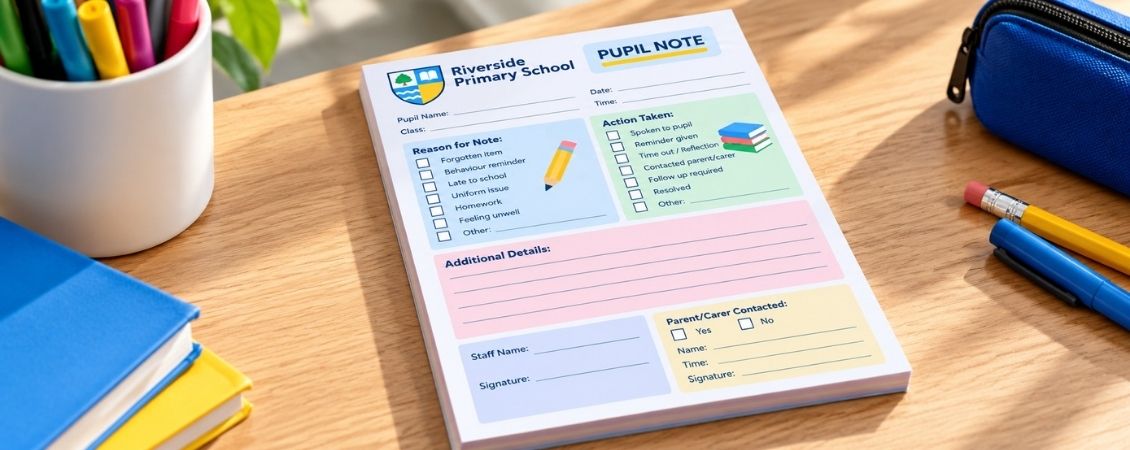
NCR pads are used whenever two or more people need the same written information.
A customer might need confirmation of what they ordered. A tradesperson might need a record of work completed. The accounts team might need the details for invoicing. With an NCR pad, each person can receive a copy created from the same original entry.
They’re especially helpful when work happens away from a desk. You don’t need a signal, battery, printer or login. Simply complete the form and hand over the relevant copy.
NCR pads can also complement digital systems. The handwritten form captures information at the point it’s needed, then the office copy can be entered into the appropriate system later.
Table Of Contents
- Common Uses For NCR Pads
- Different Ways To Use NCR Pads
- Choosing Duplicate, Triplicate Or Quadruplicate Pads
- How To Design A Useful NCR Pad
- One Pad, Plenty Of Possibilities
Common Uses For NCR Pads
Invoices And Receipts
Invoices and receipts are among the most familiar NCR pad uses.
The business keeps one copy while the customer receives another as an immediate record of the transaction. A personalised layout can include space for products, services, quantities, prices, VAT and payment details.
Adding sequential numbering makes each invoice or receipt easier to identify later. That’s particularly useful for market traders, mobile businesses and teams that take payments at a customer’s premises.
Quotes And Estimates
When discussing a job face to face, an NCR quote pad lets you leave the customer with a written estimate while keeping an identical copy.
Include sections for the proposed work, materials, estimated costs, exclusions and the period for which the quote remains valid. Both sides then have the same information to refer to when deciding what happens next.
Job Sheets And Service Reports
Plumbers, electricians, mechanics, engineers and other service professionals can use NCR pads to document the work they’ve completed.
A job sheet could include:
- Customer and site details
- The problem reported
- Work carried out
- Parts or materials used
- Follow up action required
- Customer approval or signature
The customer gets a clear account of the visit while the business receives the information needed for invoicing, stock control or booking further work.
Delivery And Collection Notes
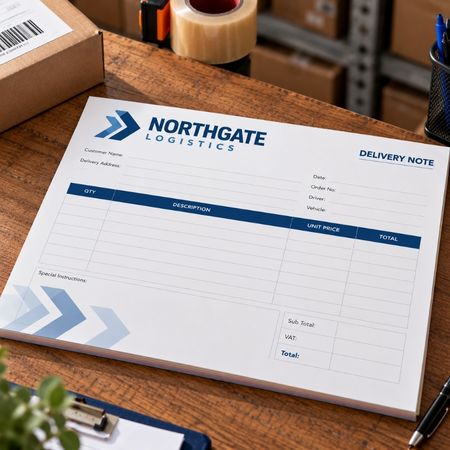
NCR pads provide a straightforward way to record what was delivered or collected, where it went and who accepted it.
The driver and recipient can each keep a signed copy. If a query crops up later, both sides have a matching record rather than two different versions of events.
Sequential numbering can also connect each delivery note to a specific customer, order or route.
Order Forms
Restaurants, wholesalers, suppliers and businesses taking orders in person can use NCR pads to keep customers and fulfilment teams on the same page.
One copy can follow the order to the person preparing it, another can go to accounts and another can be handed to the customer. This is particularly helpful for bespoke orders where the details are too important to leave to memory.
Inspection And Maintenance Forms
NCR pads can turn routine checks into clear, repeatable processes.
They’re useful for vehicle inspections, cleaning checks, property visits, equipment servicing and workplace maintenance. A pre-printed checklist prompts the person carrying out the inspection, while the copies provide immediate records for the relevant people or departments.
Accident And Incident Forms
An NCR form can help businesses document an accident or incident consistently. The layout can prompt users to record details such as the date, time, location, people involved and action taken.
However, an ordinary NCR pad shouldn’t automatically be treated as a substitute for a compliant accident book or formal reporting process. The Health and Safety Executive’s record-keeping guidance explains which incidents businesses must record or report and how personal information should be protected.
Different Ways To Use NCR Pads
The best alternative uses start with a simple question: where does your business need two people to leave with the same information?
Equipment Loans And Handovers
Whether you’re lending out tools, laptops, keys or event equipment, an NCR handover form can record exactly what changed hands.
Include the item, serial number, accessories, condition, collection date and expected return time. Both parties can sign the form and keep a copy.
This approach could work for rental businesses, schools, community organisations, production crews or any workplace with shared equipment.
Bespoke Orders At Markets And Pop-Up Shops
Personalised products often begin with a conversation. Unfortunately, conversations can become rather hazy after a full day at a busy market.
An NCR order pad can capture the customer’s chosen size, colour, wording, personalisation details, collection arrangements and payment status. The customer leaves with confirmation while the maker keeps an exact production brief.
It’s especially useful for cake makers, florists, artists, jewellers, clothing brands and other businesses offering made-to-order products.
Repair Intake Forms
Repair shops, jewellers, alteration services and technology businesses can use NCR pads when accepting customers’ belongings.
A form can record the item’s current condition, any accessories supplied, the requested work and an estimated collection date. One copy becomes the customer’s collection slip while another stays with the item or repair team.
Numbering each set gives the customer, job and item the same reference, which can make everything much easier to reunite.
Event Check-Ins
An NCR pad can give event organisers an immediate record of exhibitors, contractors, speakers or performers arriving on site.
The organiser keeps one copy while the visitor receives another containing their reference number, allocated area or instructions. This can be useful when a venue has unreliable Wi-Fi or several teams need to coordinate arrivals.
Competitions And Prize Draws
NCR pads can put a useful spin on event competitions.
The organiser keeps the entry while the participant receives a copy containing their answer, entry number or instructions for checking the result. The customer copy could also act as a voucher or reminder of where to find the business after the event.
If you collect personal information or plan to contact entrants afterwards, explain clearly how their details will be used. The Information Commissioner’s Office offers guidance on how to collect information and generate leads lawfully.
Event Kit Check-Outs
Busy events involve a steady flow of radios, passes, keys, uniforms and other equipment.
An NCR check-out form can show who has taken each item and when it should be returned. The organiser keeps one copy while the team member takes another.
It’s a simple alternative to relying on sticky notes, memory or a group chat that’s already overflowing with messages.
Property And Vehicle Condition Records
An NCR form can document the condition of a room, venue, vehicle or piece of equipment before and after use.
This could be helpful for studio hire, event venues, removal businesses, garages or companies lending items to customers. Both sides can agree on the recorded condition and keep an identical copy, with space for notes about any existing marks or damage.
Workshop Action Plans
A workshop can leave people buzzing with ideas. A week later, those ideas may be buried beneath several hundred emails.
An NCR action sheet lets each participant record the steps they’ve committed to taking. They keep one copy as a reminder while the trainer retains another for an agreed follow-up.
It turns a simple form into a practical accountability tool.
Customer Requests And Service Promises
NCR pads can also capture the small commitments that make a big difference to customer experience.
A form might record a special request, complaint resolution, promised callback or agreed collection date. The customer knows what to expect while the business has a clear action to complete.
This can be particularly useful when responsibility passes from a customer-facing team to colleagues behind the scenes.
Choosing Duplicate, Triplicate Or Quadruplicate Pads
The right format depends on how many people need a copy.
Duplicate NCR pads contain two parts: the original and one copy. They’re ideal for simple exchanges between a business and its customer.
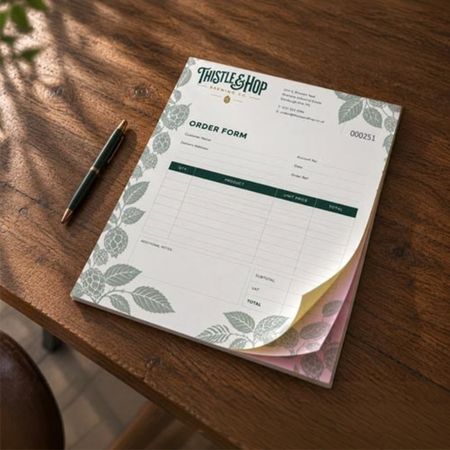
Triplicate NCR pads contain three parts: the original and two copies. One might go to the customer, another to the person carrying out the work and the third to the office.
Quadruplicate NCR pads contain four parts: the original and three copies. They suit processes involving several teams, sites or stages, such as the customer, driver, warehouse and accounts department.
More copies aren’t automatically better. Before choosing, map out where the information needs to go and which people genuinely need their own version.
How To Design A Useful NCR Pad
A good NCR pad should make completing a task easier, not give someone another form to wrestle with.
Start by deciding what the form needs to achieve. Then include only the fields required to support that process. Clear labels, logical sections and enough writing space will make the pad quicker to use and easier to understand.
Tick boxes work well for common answers, while an open notes section allows for anything unexpected. If a form needs approval, include a clear place for names, signatures and dates.
Personalising the pad with your logo and contact details can make customer facing paperwork feel more professional. Numbering each set also makes it easier to find a particular order, job or transaction later.
Finally, think about every copy. If the customer, accounts team and delivery driver each receive one, make sure the form contains something useful for all three.
One Pad, Plenty Of Possibilities
So, what are NCR pads used for? In short, they’re used whenever people need matching copies of information quickly, clearly and without relying on technology.
Invoices, receipts and delivery notes remain popular for good reason. But NCR pads can be just as useful for bespoke orders, repair bookings, equipment handovers, events and customer action plans.
Look at the moments where information currently gets lost, forgotten or misunderstood. If the process involves hurried notes, crossed wires or someone saying, “I’m sure that’s what we agreed”, a personalised NCR pad could be a refreshingly simple answer.
.jpg)