As workplace language continues to evolve, we took a fun dive into the phrases dividing the office by surveying 2,000 UK office workers to find out just how well different generations understand each other.
From ‘rage applying’ and ‘Bare Minimum Monday’ to ‘blue-sky thinking’ and getting your ‘ducks in a row’, every generation has its own workplace vocabulary. But while some phrases might seem completely normal to you, they could leave the colleague sitting next to you wondering what on earth you are talking about.
Our survey put different generations to the test, asking office workers to translate workplace slang and jargon from outside their own generation. We also explored whether employees ever pretend to understand phrases they have never heard before, which expressions they would happily ban from the office and whether confusing workplace language has ever caused a genuine misunderstanding.
Think your workplace vocabulary gives away your age? Take our Workplace Translation Test below to find out whether your 9-to-5 language is giving Gen Z, Millennial, Gen X or Baby Boomer.

How old do you sound at work?
We asked 2,000 UK office workers to translate each other's jargon — from "rage applying" to "blue-sky thinking." This isn't a test of what you understand, it's a test of what you'd actually say. Tell us honestly for 8 phrases, and we'll tell you which generation your workplace vocabulary belongs to.
Be honest — is this in your regular vocabulary?
Millennial
…
Phrases the office wants banned forever
42% of workers say there's at least one workplace phrase they'd happily never hear again.
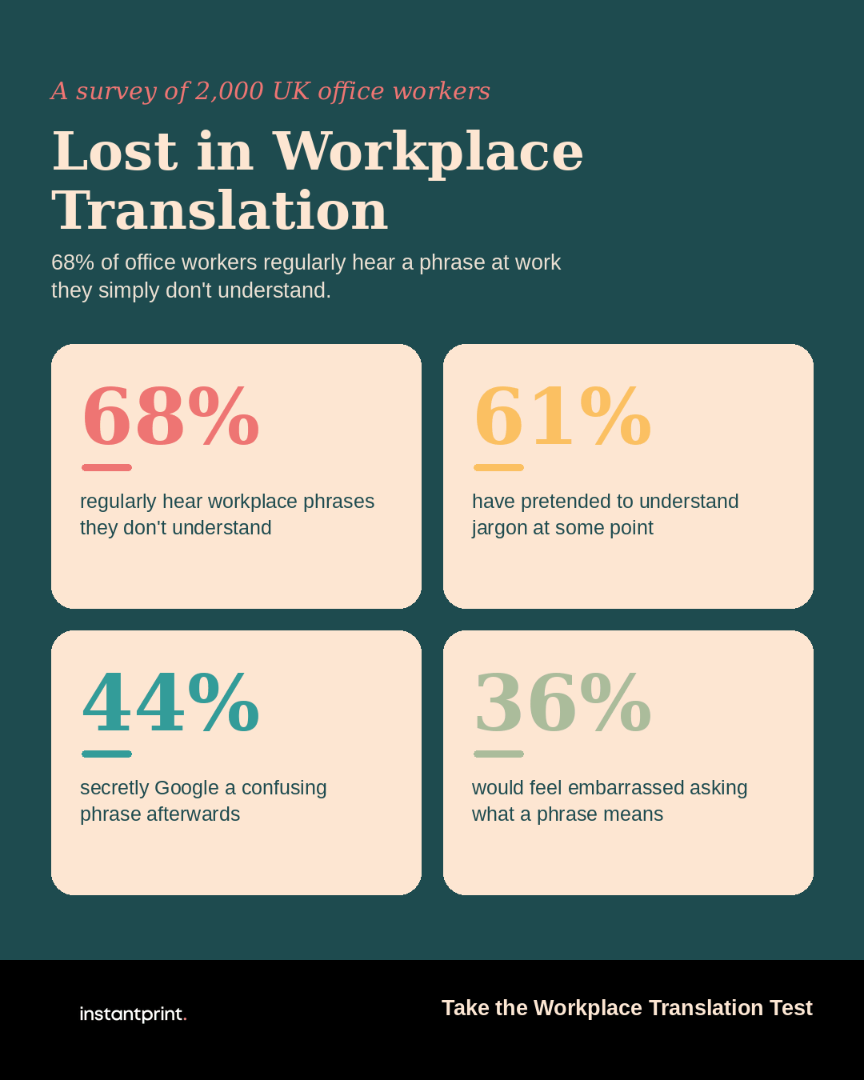
Lost in Workplace Translation
It turns out plenty of us are getting lost in translation at work, with 68% of office workers saying they regularly hear workplace phrases they do not understand.
Rather than admit they are confused, 61% have pretended to understand workplace jargon at some point, choosing to nod along rather than ask what something actually means.
For those who do decide to investigate, 44% admit to secretly Googling a phrase afterwards, while 32% have asked a trusted colleague for a translation. Another 27% simply try to work it out from context and hope for the best!
And there might be a reason we are reluctant to ask. More than a third, 36%, of workers say they would feel embarrassed asking someone from another generation what a workplace phrase means.
Rage Applying, Anyone?
We put some of the most popular newer workplace phrases in front of older generations to see how fluent they really are in modern office slang.
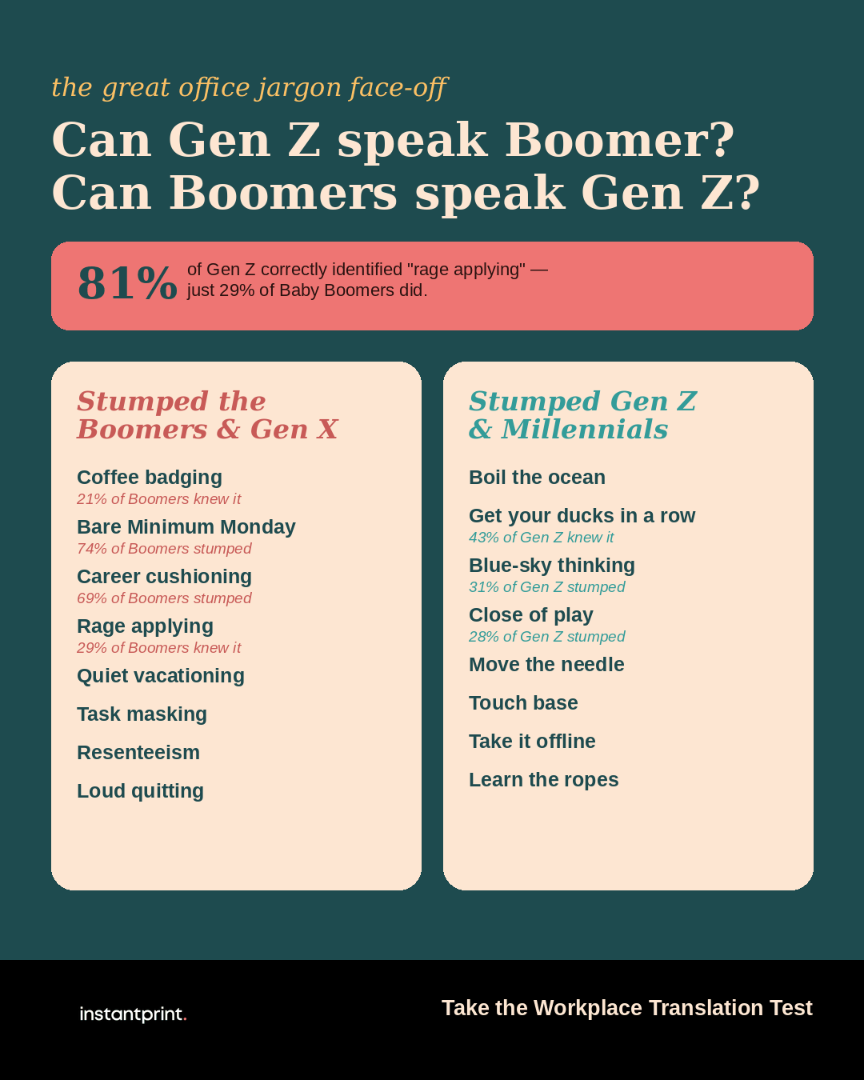
‘Rage applying’, which refers to applying for multiple jobs after becoming frustrated with your current one, was correctly identified by 81% of Gen Z workers, compared with just 29% of Baby Boomers.
‘Coffee badging’ proved even trickier, with only 21% of Boomers and 34% of Gen X correctly identifying what it means.
Meanwhile, 74% of Boomers were stumped by ‘Bare Minimum Monday’, while 69% could not correctly identify ‘career cushioning’.
The 10 modern workplace phrases older generations struggled with most were:
- Coffee badging
- Bare Minimum Monday
- Career cushioning
- Rage applying
- Quiet vacationing
- Task masking
- Resenteeism
- Loud quitting
- Lazy-girl job
- Quiet quitting
Some of these might sound perfectly normal if your lunch break involves a scroll through TikTok, but for plenty of workers they are still firmly in translation territory.
But Can Gen Z Speak Boomer?
Before Gen Z gets too smug about knowing their ‘coffee badging’ from their ‘career cushioning’, we flipped the test around and asked younger workers to decipher some more traditional office sayings.
And it turns out the confusion definitely goes both ways!
Only 38% of Gen Z workers correctly understood what it means to ‘boil the ocean’, while fewer than half, 43%, knew what a colleague meant when they said they needed to get their ‘ducks in a row’.
Even some office classics caused confusion, with 31% unable to correctly identify ‘blue-sky thinking’ and 28% struggling with ‘close of play’.
Across the whole translation test, Gen Z correctly identified an average of 5.9 out of 10 traditional workplace phrases, while Baby Boomers managed 4.2 out of 10 newer expressions.
The 10 traditional workplace phrases younger generations struggled with most were:
- Boil the ocean
- Get your ducks in a row
- Blue-sky thinking
- Close of play
- Move the needle
- Touch base
- Take it offline
- Back to the drawing board
- Learn the ropes
- Think outside the box
So, whether your workplace vocabulary was shaped by TikTok or decades of office meetings, nobody is completely fluent in every generation’s jargon.
Are We Just Pretending We Know What Everyone Means?
While our translation skills might need some work, our confidence certainly does not!
Before taking the test, 72% of respondents rated their understanding of workplace language as ‘good’ or ‘very good’. However, when actually put to the test, the average worker correctly identified just 57% of phrases from outside their own generation.
And each generation seems to think its own way of speaking is pretty straightforward.
Almost three quarters, 74% of Gen Z respondents, believe their generation’s workplace language is easy for everyone to understand, yet only 46% of workers aged 45 and over agree.
Likewise, 69% of workers aged 55+ think traditional office idioms are easy to understand, compared with just 48% of Gen Z.
It seems the workplace language gap is not always down to what we know, but what we assume everyone else knows too.
Can Your Workplace Vocabulary Give Away Your Age?
Forget asking someone what year they were born, their favourite workplace phrase might tell you everything you need to know!
More than half, 52% of UK office workers, say they can often guess a colleague’s age based on the language they use at work.
Phrases such as ‘touch base’, ‘close of play’ and ‘move the needle’ were among those younger workers most strongly associated with older colleagues.
Meanwhile, ‘rage applying’, ‘quiet quitting’ and ‘it’s giving’ were some of the biggest giveaways for younger employees.
Interestingly, 58% of workers say they deliberately change the language they use depending on the age of the colleague they are speaking to, rising to 67% among Gen Z respondents.
So, while we may not consciously think about it, many of us are already translating our workplace language depending on who is listening.
When Jargon Gets More Than a Little Confusing
Most of the time, misunderstanding a workplace phrase might result in a quick Google search or an awkward nod in a meeting. However, sometimes getting lost in translation can have bigger consequences.
Almost one in five, 18% of workers, say unfamiliar workplace language has caused them to misunderstand an instruction, while 12% say it has contributed to them making a mistake at work.
Almost a quarter, 24%, have felt excluded from a workplace conversation because they did not understand the language being used, while 17% have avoided contributing to a meeting because they were unsure what certain phrases meant.
Overall, 39% believe excessive jargon makes workplace communication less efficient, while 35% think it can make workplaces feel less inclusive.
For businesses with several generations working alongside one another, that makes language more than just a fun cultural difference. Sometimes, clarity really does matter.
The Workplace Phrases We’d Happily Never Hear Again
Whether you are Team ‘Circle Back’ or cannot hear ‘Think Outside the Box’ one more time, there are some office phrases that have definitely worn out their welcome.
In fact, 42% of workers say there is at least one workplace phrase they would happily ban forever.
We asked respondents which workplace expressions they would most like to remove from office vocabulary. Here are the 10 phrases workers are officially tired of hearing:
- Let’s circle back
- Think outside the box
- Touch base
- It is what it is
- We’re like a family here
- Move the needle
- Quiet quitting
- It’s giving
- Blue-sky thinking
- Work hard, play hard
It appears there is one thing every generation can agree on, some phrases have simply had their day.
How to Stop Your Workplace Getting Lost in Translation
Vicki Russell, Head of TX (HR) at instantprint, says that while every generation naturally develops its own language, a little extra clarity can go a long way in a multigenerational workplace.
“Every generation has phrases that feel completely normal to them, whether that is ‘circle back’ or ‘rage applying’. The problem comes when we assume everyone else knows exactly what we mean.
“Workplace language should make communication easier, not leave people quietly Googling something after a meeting. You do not need to stop using slang or jargon completely, but being conscious of who you are speaking to can help make sure nobody feels left out of the conversation.”
Vicki shares her tips for avoiding getting lost in workplace translation:
- Don’t assume everyone knows what you mean. If a phrase is important to an instruction or deadline, use straightforward language alongside it. What feels obvious to you might be completely unfamiliar to someone else.
- Make it normal to ask. Creating a workplace where people feel comfortable asking what something means can help avoid confusion further down the line. Managers can help by being willing to ask for clarification themselves.
- Think before you jargon. Before hitting send on an email or Teams message, consider whether someone outside your immediate team or generation would understand it. If not, there is probably a simpler way to say it.
- Know your audience. You do not need to completely change how you speak, but adapting your language slightly depending on who you are talking to can make communication much clearer.
- Check everyone is on the same page. For important instructions, deadlines or projects, give people an opportunity to ask questions rather than assuming your message has translated perfectly.
With Gen Z, Millennials, Gen X and Baby Boomers all sharing workplaces, there have arguably never been more versions of ‘office speak’ flying around at once.
That does not mean we all need to start talking the same way. After all, a workplace without slang, sayings or the occasional questionable bit of jargon might be a pretty boring place to spend eight hours a day.
But with 61% of workers admitting they have pretended to understand workplace jargon, it might be worth thinking twice before assuming everyone knows exactly what you mean when you ask them to circle back after close of play.
Still convinced your workplace vocabulary does not give your generation away? Take the Workplace Translation Test and find out how old you really sound at work.
Then let us know which workplace phrase you would happily ban forever on social media using @instantprintuk