You’ve probably heard marketers talk about funnels. Sales funnels, content funnels, lead generation funnels. Funnels, funnels everywhere.
Thankfully, the idea is much simpler than the terminology makes it sound.
A marketing funnel is a way of describing the journey someone takes from discovering your business to becoming a customer and, ideally, buying from you again.
It helps you understand what potential customers need at different points in that journey. Someone encountering your business for the first time probably isn’t ready for a hard sell. A person comparing your product with three alternatives needs different information from someone who has already ordered from you.
Once you understand that, your marketing can become much more focused.
What Is a Marketing Funnel?
A marketing funnel is a framework that divides the customer journey into stages.
At the top are people who have only just become aware of your business. As they learn more, some will become interested and consider buying. A smaller number will eventually complete a purchase.
The funnel can also continue beyond that first sale, covering repeat purchases, loyalty and recommendations.
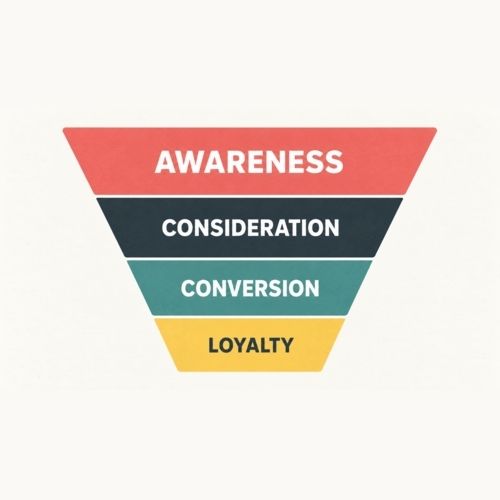
In simple terms, it looks like this:
- Awareness: Someone discovers your business.
- Consideration: They decide whether your offer is right for them.
- Conversion: They take the action you want, such as making a purchase.
- Loyalty: You give them reasons to return and recommend you.
There’s no single official version of the marketing funnel. Some models use three stages while others use five or more. Awareness, consideration, conversion and loyalty provide a useful starting point for most small businesses. Amazon Ads also uses these four stages in its explanation of the marketing funnel.
Why Is It Called a Funnel?
Picture the shape of a kitchen funnel. It’s wide at the top and narrow at the bottom.
Your marketing funnel works in a similar way. Lots of people might see one of your social posts, walk past your shop or find your website through Google. Only some of those people will want to learn more and fewer will make a purchase.
For example:
- 2,000 people see a local bakery’s social media post
- 200 visit its website or profile
- 50 look at the menu
- 15 place an order
- 5 return the following month
Those figures are only an illustration, but they show why the model narrows. Not everyone who notices a business will become a customer.
That isn’t necessarily a sign that your marketing has failed. The aim is to help the right people move forward while learning where others lose interest.
What Are the Stages of a Marketing Funnel?
Let’s look more closely at the four main stages and what your customers might need during each one.
1. Awareness
At the awareness stage, a potential customer discovers that your business exists.
They might find you through:
- A Google search
- Social media
- A recommendation
- An advert
- A blog post or video
- A sign, poster or leaflet
- An event or networking opportunity
Your job at this stage is to attract attention and make your business memorable. You’re introducing yourself, not proposing marriage on the first date.
Focus on the problems you solve and the value you offer. Helpful content, recognisable branding and clear messaging can all give people a reason to remember you.
Useful measurements at this stage include website visits, search impressions, social reach and new followers.
2. Consideration
At the consideration stage, someone knows about your business and is deciding whether you’re the right choice.
They may be looking at your website, comparing prices, reading reviews or checking whether you offer exactly what they need. They might also be comparing you with competitors.
This is where clear, useful information earns its keep. Product details, FAQs, demonstrations, reviews and case studies can all help potential customers feel more confident.
Imagine you run a dog grooming business. A potential customer might want to know:
- What services do you offer?
- How much does an appointment cost?
- Do you have experience with their breed?
- What do previous customers say?
- Where are you based?
- How soon can they book?
If that information is difficult to find, they may move on even if your service would have been perfect for them.
3. Conversion
Conversion is the stage where a potential customer takes your desired action.
That could mean buying a product, booking an appointment, requesting a quote or signing up for a paid service. The right conversion depends on your business.
At this point, the customer may only need a final nudge and a smooth path forward. Clear calls to action, straightforward pricing, convenient payment options and a simple checkout or enquiry process can make a big difference.
Look for any unnecessary friction. Are you asking customers to complete a huge form? Is the booking button hard to find? Are delivery costs revealed at the last moment?
The easier it is to take the next step, the less likely someone is to abandon the process.
4. Loyalty
The funnel shouldn’t end as soon as money changes hands.
Existing customers already know your business and have decided to trust it. A good experience can encourage them to return, spend more over time and recommend you to other people.
Loyalty marketing might include:
- Helpful follow-up emails
- Excellent customer service
- Reorder reminders
- Loyalty rewards
- Exclusive offers
- Requests for reviews
- Referral incentives
The goal isn’t to bombard customers with messages. It’s to continue being useful and give them a reason to choose you again.

A Simple Marketing Funnel Example
Let’s follow a fictional business through the funnel.
Sophie owns a small bakery specialising in celebration cakes.
At the awareness stage, a local parent sees one of Sophie’s birthday cake videos on Instagram.
During consideration, they visit the bakery’s website, browse the gallery, check prices and read customer reviews. They also look at another local baker before deciding which one feels right.
At the conversion stage, they use a short online form to request a cake for their child’s birthday. Sophie responds promptly, confirms the design and takes payment.
At the loyalty stage, Sophie sends a thank-you message with storage tips. Several months later, she emails a friendly reminder about seasonal cakes. The customer orders again and recommends the bakery to a friend.
This journey could take a few minutes, several days or much longer. Customers don’t always move through a funnel in a neat sequence either. They may discover a business, forget about it, see it again and only start considering a purchase weeks later.
The funnel is a useful guide rather than a strict set of rules.
Why Does Your Small Business Need a Marketing Funnel?
Without a funnel, marketing can feel like a collection of unrelated tasks. You post on social media, send an email and update your website, but you’re not quite sure how those activities work together.
Thinking in funnel stages helps you give each activity a purpose.
It can help you:
- Understand what customers need before they buy
- Choose suitable marketing channels and messages
- Identify where potential customers lose interest
- Make better use of your time and budget
- Improve the customer experience
- Encourage repeat business
Suppose plenty of people visit your website but very few request a quote. Awareness may not be the problem. You might need clearer service information, stronger reviews or a simpler enquiry form.
That’s much more useful than deciding that all your marketing needs to be replaced.
How to Create a Marketing Funnel
You don’t need expensive software or a complicated automation system to create your first marketing funnel. Start with your customer and work backwards.
Define the Action You Want Customers to Take
Choose one main result, such as making a purchase, booking a consultation or requesting a quote.
A funnel becomes difficult to plan when it’s trying to achieve several unrelated goals at once.
Understand Your Customer
Think about who they are, what problem they’re trying to solve and what could prevent them from buying.
Speak to existing customers if you can. The questions they asked before purchasing can reveal what future customers are likely to need.
Map the Journey
Write down the steps someone might take between discovering your business and completing your chosen action.
For example:
Google search → blog post → service page → reviews → enquiry form → follow-up email
You may have several routes into the same funnel. Someone else could begin with a leaflet or personal recommendation before visiting the same service page.
Create Something Useful for Each Stage
Match your marketing to what customers need at that moment.
At the awareness stage, you might use educational blog posts, local advertising or social content. During consideration, you could provide detailed service pages, testimonials or examples of your work. At conversion, focus on a clear offer and an easy buying process.
After the sale, think about the support, communication or incentive that could bring the customer back.
Connect the Stages
Every piece of marketing should offer a sensible next step.
A blog post might link to a relevant service. A leaflet could include a QR code leading to a landing page. A quote email might contain a clear booking button.
The next step doesn’t always need to be “buy now”. It simply needs to make sense for someone at that stage.
How to Measure Your Marketing Funnel
You don’t need to track every number available. Choose a few measurements that tell you whether people are progressing.
You could monitor:
- Awareness: Reach, impressions, website visitors or local enquiries
- Consideration: Product page views, guide downloads, email sign-ups or quote requests
- Conversion: Purchases, bookings, leads or conversion rate
- Loyalty: Repeat purchases, reviews, referrals or returning customers
Look for the points where interest drops sharply.
If an advert attracts clicks but visitors quickly leave the landing page, the advert may be promising something the page doesn’t deliver. If customers add products to their baskets but don’t complete checkout, the buying process may be creating doubt or friction.
Treat your funnel as something to improve gradually. Small changes are easier to measure than changing everything at once.
Common Marketing Funnel Mistakes
One common mistake is focusing only on awareness. Plenty of attention feels encouraging, but followers and website visits won’t automatically turn into sales.
The opposite mistake is asking everyone to buy immediately. New audiences often need time and information before they feel ready.
Other pitfalls include:
- Using the same message at every stage
- Making the next action unclear
- Ignoring customers after their first purchase
- Tracking impressive-looking numbers that don’t support a business goal
- Assuming every customer follows exactly the same route
- Adding more tools before fixing the basic journey
Keep your first funnel simple. A clear customer journey supported by a few well-chosen activities is more useful than a complicated diagram nobody uses.
Frequently Asked Questions
What is the difference between a marketing funnel and a sales funnel?
A marketing funnel usually covers how people discover, understand and engage with a business. A sales funnel focuses more closely on turning interested prospects into paying customers.
The two often overlap, especially in a small business where the same person may handle both marketing and sales.
What do TOFU, MOFU and BOFU mean?
These abbreviations describe different parts of the funnel:
- TOFU: Top of funnel, usually focused on awareness
- MOFU: Middle of funnel, usually focused on consideration
- BOFU: Bottom of funnel, usually focused on conversion
They may sound technical, but they’re simply shorthand for how close someone is to making a purchase.
Do I need special software to build a marketing funnel?
No. You can sketch a basic funnel on paper or create one in a spreadsheet.
Software can help with email automation, customer management and reporting as your business grows. It won’t replace a clear understanding of your customer or fix an offer that people don’t want.
Are marketing funnels only for online businesses?
Not at all. An offline journey might begin with a shop sign, networking conversation, event or leaflet before continuing online or leading directly to a sale.
Most modern funnels contain a mixture of touchpoints. A customer might see a poster, search for the business online, read reviews and then visit in person.
In Conclusion
A marketing funnel helps you see your business from the customer’s perspective.
Instead of expecting every advert, post or email to produce an immediate sale, you can give people the right information at the right stage. You can attract attention, build confidence, make purchasing easier and stay connected after the sale.
Start by mapping one common route your customers take. Identify what they need at each stage and choose one or two ways to help them move forward.
Your first funnel doesn’t need to be perfect. It simply needs to make the journey towards your business easier to understand and easier to complete.
.jpg)