New instantprint research reveals that most consumers struggle to identify AI-generated marketing materials, as businesses increasingly embrace artificial intelligence to save time and boost productivity.
Artificial intelligence is rapidly changing the way businesses create marketing materials. What began as a tool for generating ideas and automating repetitive tasks has evolved into a creative partner capable of producing everything from social media graphics and advertising campaigns to flyers, posters and direct mail. As the technology becomes more sophisticated, many businesses are embracing AI as a faster and more affordable way to produce marketing content.
Yet despite the growing debate around artificial intelligence and its impact on creative industries, new research suggests that consumers may already be struggling to tell the difference between AI-generated marketing and work created by human designers.
According to a new instantprint study, seven in ten consumers were unable to correctly identify whether a marketing campaign had been created by artificial intelligence or a professional designer. The findings come as businesses increasingly turn to AI tools to save time, reduce costs and increase the volume of marketing content they can produce.
The results raise an interesting question for marketers. If consumers can no longer reliably distinguish between AI-generated and human-created marketing materials, what does that mean for the future of creativity, branding and business communication?
The Great Summer Marketing Experiment
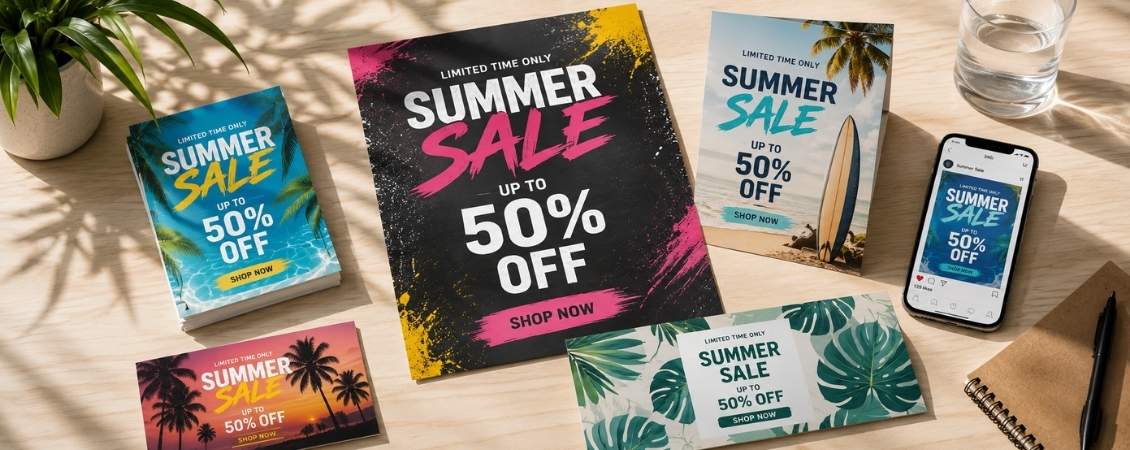
To explore how consumers perceive AI-generated marketing, instantprint conducted a summer marketing experiment using two separate campaign concepts created from the same creative brief. One campaign was developed using AI design tools, while the other was produced by professional designers.
Participants were shown a selection of campaign assets, including promotional posters, printed flyers and social media advertisements, before being asked a series of questions about quality, effectiveness and whether they believed the work had been created by AI or a human.
The findings revealed just how far artificial intelligence has progressed in a relatively short space of time. While many respondents felt confident in their ability to identify AI-generated content, the majority struggled to correctly distinguish between the two campaigns.
In total, 70% failed to correctly identify which campaign had been created using AI, while only 12% of respondents accurately identified every asset. More than half (54%) admitted they were surprised by the quality of the AI-generated designs once they discovered which campaign had been created by artificial intelligence.
The results suggest that, at least from a visual perspective, the gap between AI-generated design and traditional creative work is becoming increasingly difficult for consumers to recognise.
Businesses Are Turning To AI In Record Numbers
The rapid improvement in AI-generated content helps explain why adoption has accelerated so quickly among businesses. What once required specialist software, extensive training and significant creative resources can now be achieved in a matter of minutes using accessible AI tools.
Our research found that nearly three-quarters (72%) of business owners and marketers have used AI to create marketing materials during the past year. From generating campaign ideas and writing promotional copy to creating imagery and social media content, artificial intelligence is becoming an increasingly common part of the marketing toolkit.
For many businesses, the biggest benefit is efficiency. More than six in ten respondents (63%) said AI saves them at least three hours every week on marketing-related tasks, while almost a third (29%) estimated that AI saves them the equivalent of more than one full working day each month.
In an increasingly competitive environment where small businesses are expected to maintain a constant presence across multiple channels, those time savings can have a significant impact. More than half of respondents (52%) said AI has enabled them to create more marketing content than they would have been able to produce previously, allowing them to promote their businesses more consistently and react more quickly to opportunities.
Why Human Creativity Still Matters
Despite the growing popularity of AI-generated marketing, the research suggests businesses are not ready to hand over the creative process entirely.
While consumers struggled to identify which campaigns had been created by AI, many respondents still associated qualities such as originality, emotional storytelling and brand personality more strongly with human-created work. When asked what factors contribute most to memorable marketing campaigns, respondents consistently highlighted creativity, authenticity and audience understanding as key differentiators.
This reflects a wider shift in how businesses are approaching artificial intelligence. Rather than viewing AI as a replacement for creative professionals, many organisations are increasingly using it as a tool to support and accelerate creative processes.
Artificial intelligence can generate ideas, explore concepts and produce marketing assets at remarkable speed. However, strategic thinking, brand positioning and understanding human behaviour remain areas where experienced marketers and designers continue to play a vital role.
As AI becomes more capable, the distinction between human and machine-created work may become less important than how effectively both are used together.
The Hidden Challenge Of AI-Generated Marketing
As more businesses embrace AI-generated content, another issue is beginning to emerge behind the scenes.
While many AI-generated designs look impressive on screens, creating artwork that is suitable for professional print production presents a different challenge entirely. Resolution, colour profiles, image quality and file setup all play a crucial role in determining how marketing materials will look once they reach the printing stage.
Our research found that 46% of business owners were unfamiliar with CMYK colour requirements for print, while 38% said they had experienced quality issues when printing artwork generated by AI tools. Common challenges included low-resolution imagery, inconsistent colours and designs that appeared sharp digitally but failed to reproduce effectively in physical formats.
As businesses increasingly use AI to create flyers, posters, leaflets and other printed materials, ensuring artwork is properly prepared for production will become increasingly important. The quality of a design is ultimately judged not only by how it appears on screen, but by how it performs in the real world.
At instantprint, we're seeing a growing number of customers submit AI-generated artwork for print. To help businesses achieve the best possible results, all artwork is checked before production and supported by built-in AI upscaling technology that automatically enhances lower-resolution designs. This helps ensure customers can take advantage of the speed and convenience of AI-generated content while maintaining the professional print quality their brands depend on.
The Future Of Marketing Is Collaboration
The findings suggest that predictions of a battle between AI and human creativity may be missing the bigger picture.
Consumers increasingly struggle to distinguish between AI-generated and human-created marketing materials, while businesses are using artificial intelligence to save time, increase efficiency and produce more content than ever before.
At the same time, the qualities that underpin great marketing - strategic thinking, creativity, storytelling and audience understanding remain highly valued.
Rather than replacing human creativity, AI appears to be reshaping the way creative work is produced. Businesses are gaining access to powerful tools that help them work faster and more efficiently, while marketers and designers can focus more of their time on strategy, innovation and creative development.
As summer marketing campaigns continue to evolve throughout 2026 and beyond, the most successful businesses may not be those choosing between AI and humans. Instead, they are likely to be the organisations that understand how to combine the strengths of both.
.jpg)