Think about the last time someone in your business had to pass information to another person.
Perhaps a driver needed a signature, a customer approved some work or a member of staff handed an order to the kitchen. Maybe someone scribbled the details on a scrap of paper, took a photo and promised to enter it into the system later.
These little handovers happen all day. When they work, nobody notices. When they don’t, you get missing details, confused customers and messages asking, “Do you still have a copy of that form?”
That’s the problem NCR pads are designed to solve.
What Is an NCR Pad?
NCR stands for No Carbon Required. The pad contains sets of specially coated paper which create several copies of the same handwritten information.
When you write on the top sheet, pressure from the pen transfers your writing onto the sheets underneath. You only fill in the form once, but you finish with two, three or four matching copies.
There’s no loose carbon paper to position and no need to photocopy the finished form. One copy can go to the customer while the others travel back through the business.
It’s a simple idea, which is precisely why it works.
Why Does Paper Still Earn Its Place?
Most businesses already use digital tools to manage customers, payments and projects. NCR pads aren’t a replacement for those systems. They’re useful in the gaps where opening an app or reaching a printer would slow things down.
Picture an engineer working in a plant room, a delivery driver standing on a doorstep or an event team checking equipment in the middle of a field. These aren’t always ideal places to balance a laptop or depend on a reliable connection.
A handwritten form can be completed immediately. The customer gets a copy there and then, and the business has a record to refer to or add to its digital system later.
There’s also something reassuring about both people leaving a conversation with the same information. Nobody has to wait for an email to arrive or wonder whether their details were saved correctly.
Where Could an NCR Pad Make a Difference?
Invoices and receipts are familiar examples, but NCR pads can support almost any task where information changes hands.
The useful question isn’t “What can we print on a pad?” It’s “Where does our information currently get stuck?”
Look for moments when your team:
- Writes the same details more than once
- Takes photos of paperwork as a backup
- Relies on verbal instructions being remembered
- Needs a customer’s signature
- Gives one document to several departments
- Regularly loses track of loose notes
- Works somewhere without easy access to a computer
Those everyday frustrations can point towards some surprisingly useful ideas.
Ideas for Trades and Field Services
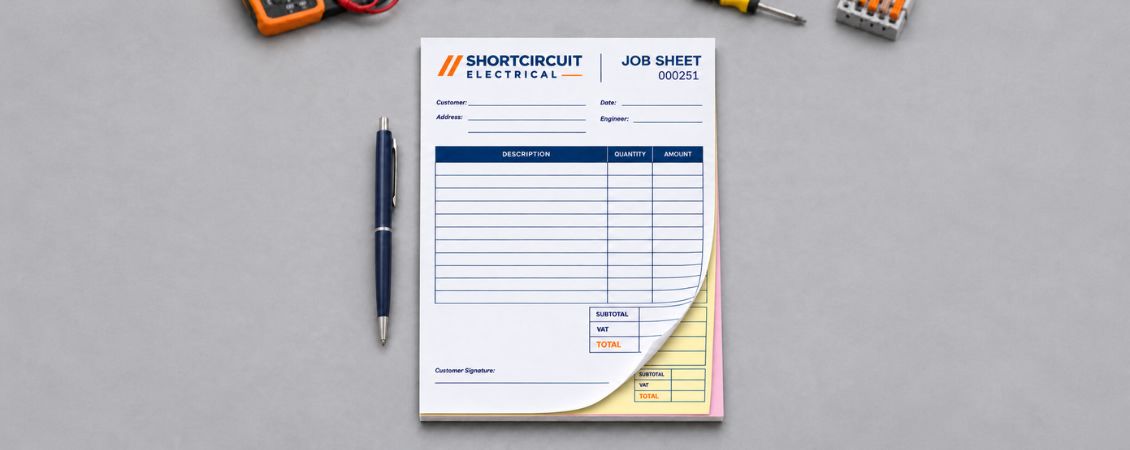
For a tradesperson, an NCR job sheet can create a clear record before anyone leaves the property.
It could include the problem reported by the customer, the work completed, parts used and any follow up work required. Both sides can sign it and keep a copy.
That can be particularly helpful when a job changes after the original quote. Perhaps an electrician discovers an additional fault or a decorator is asked to include another room. Recording the change gives everyone something clear to refer back to.
Service visits offer another opportunity. Engineers could use a checklist to record readings, tests and maintenance completed. One copy stays with the customer while another returns to the office.
Ideas for Shops and Makers
A standard till receipt doesn’t always capture the full story.
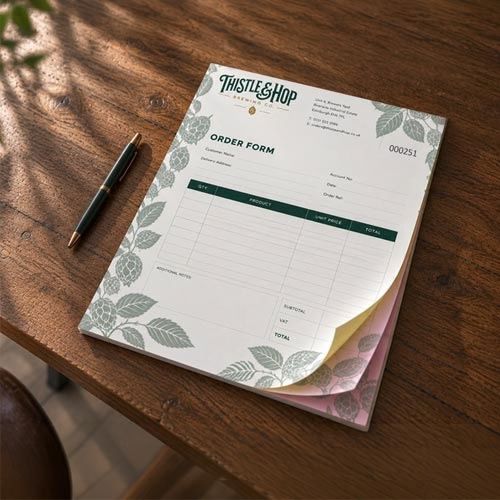
A tailor may need measurements, fabric choices and alteration notes. A jeweller might record an item’s condition before a repair. A cake maker could capture flavours, decoration ideas, allergy information and a collection time.
NCR order forms allow the customer to leave with the same details the business will use to complete the work.
This can be useful for any purchase that is personalised, repaired, made to order or collected later. Florists, picture framers, furniture makers and independent retailers could all adapt the idea to suit their process.
Ideas for Hospitality and Events
Hospitality businesses have always relied on information moving quickly.
An order may need to travel from the customer to the server, then to the kitchen and finally to the till. A triplicate pad creates a copy for each stage without anyone rewriting it.
The same thinking can be applied beyond food orders. Caterers could use NCR forms for equipment collections or last minute event changes. Venues might create room handover sheets covering keys, furniture, damage and agreed finishing times.
Event teams could use them for supplier arrivals, equipment loans or safety checks. When several businesses are working together for one day, having matching written records can prevent a lot of confusion afterwards.
Ideas for Deliveries and Hire Businesses
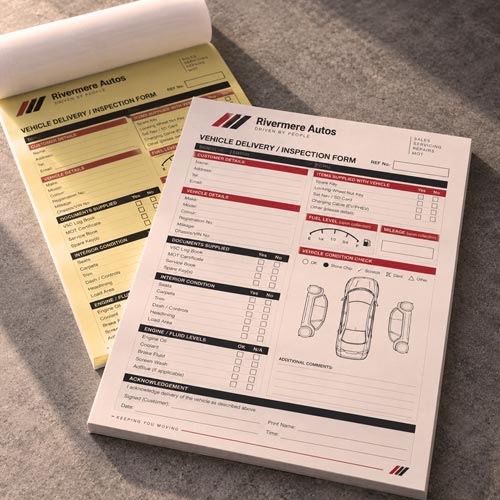
A signed delivery note does more than confirm that something arrived. It can record quantities, visible damage, missing items and the name of the person who accepted it.
For collections, the same form could capture what was taken, its condition and when it changed hands.
Hire businesses can apply this at both ends of a booking. An equipment checklist completed at collection gives the customer and business a shared starting point. A second check when the equipment returns can record any changes.
That could work for tools, bikes, formalwear, event furniture or musical equipment. The item changes, but the need for a clear handover remains the same.
Ideas for Teams Behind the Scenes
NCR pads aren’t only helpful when dealing with customers.
Facilities teams could create maintenance request forms. Warehouses might use them for stock movements. An office could record equipment issued to employees. A charity may need donation receipts when collecting money at an event.
Even a simple message pad can help when accuracy matters. Names, numbers and reference details are less likely to disappear when the person taking the message and the person handling it can each have a copy.
The most useful forms are often designed around one very specific task.
How Many Copies Do You Need?
A 2-part NCR pad, also called a duplicate pad, creates an original and one copy. It works well when information is shared between two parties, such as a business and its customer.
A 3-part or triplicate pad creates three copies. These could go to the customer, the person completing the work and the office.
A 4-part pad can support a process involving several teams or locations. For example, copies might be needed by a customer, driver, warehouse and accounts department.
Choose the format by tracing the journey of the information. Who fills in the form? Who needs to act on it? Who needs to retain a record?
If you can’t find a genuine purpose for every copy, you probably don’t need it.
Creating a Form People Will Actually Use
A form should make a task easier. If it asks too many questions or leaves nowhere to write, people will start working around it.
Begin with real examples. What information does your team regularly forget to collect? What questions do customers ask later? Which details does the next person in the process need?
Build the form around those answers.
Put fields in a natural order and use plain labels. Provide checkboxes for frequent answers, but leave room for notes when a job doesn’t follow the usual pattern. Make signature boxes large enough to use and allow more space than you think you’ll need for names and addresses.
It’s worth completing a few test forms before finalising the design. Ask someone who’ll use the pad regularly to try it too. They’ll usually spot practical problems that aren’t obvious on screen.
Sequential numbering can help when forms need to be tracked. Clear reference numbers make it easier to connect a customer’s copy with the corresponding order, job or delivery record.
When Is an NCR Pad the Right Choice?
Not every process needs to be put on paper.
If information must be searched, updated regularly or accessed by teams in several locations, a digital system may be more suitable. Paper forms also need to be stored securely, particularly when they contain personal or sensitive information.
NCR pads are at their best when information needs to be captured quickly, shared immediately and kept consistent between a small number of people.
They’re particularly useful when work takes place away from a desk or when handing someone a physical copy is part of the service.
In many businesses, the answer will be a combination of paper and digital tools. The form handles the immediate conversation or handover. The digital system looks after the information in the longer term.
Start With the Moments That Cause Friction
The best way to find a use for an NCR pad is to follow a normal day through your business.
Where do details get lost? Where does someone have to write the same thing twice? Where would a customer benefit from leaving with a clear record?
You may find the answer in a delivery being signed for, an order being passed to the kitchen or a job being approved at a customer’s home.
These moments aren’t dramatic, but improving them can make a business feel calmer, clearer and easier to deal with.
Sometimes progress looks like clever new technology. Sometimes it looks like writing something down once and giving everyone the copy they need.
.jpg)
.jpg)